Waldorf, Maryland
Storm Debris Removal in Waldorf, MD
Storm Debris Removal in Waldorf, Maryland, priced by volume against published market figures, with the price confirmed on site before loading begins.
Waldorf, Maryland
Storm Debris Removal in Waldorf, Maryland, priced by volume against published market figures, with the price confirmed on site before loading begins.
A summer storm crosses Charles County in under an hour, and the cleanup it leaves behind can sit in a Waldorf yard for weeks. Fallen branches, split fence panels, a trampoline folded into the hedge: this is the work we haul. We are Waldorf Junk Removal Company, and our storm debris removal is hauling only. Once storm damage is on the ground, we load it and take it away, along with the water damaged household items that come with a hard storm. You point at the piles. We do the lifting.
The usual load is yard wreckage: fallen limbs and branches, broken fence sections, damaged patio furniture, bent trampolines and playsets, above ground pool remains, and the contents of sheds the wind rearranged. Storms also reach inside the house, and we haul the non hazardous household items a storm ruins, like waterlogged carpet, padding, and furniture that sat in standing water.
One boundary matters, and we state it plainly. We do not cut, climb, or take down trees. A standing tree, a leaning trunk, and limbs still hanging in the canopy are tree work, and that belongs to a tree service. Our work starts where theirs ends: everything already on the ground gets loaded and hauled into the county disposal and recycling streams.
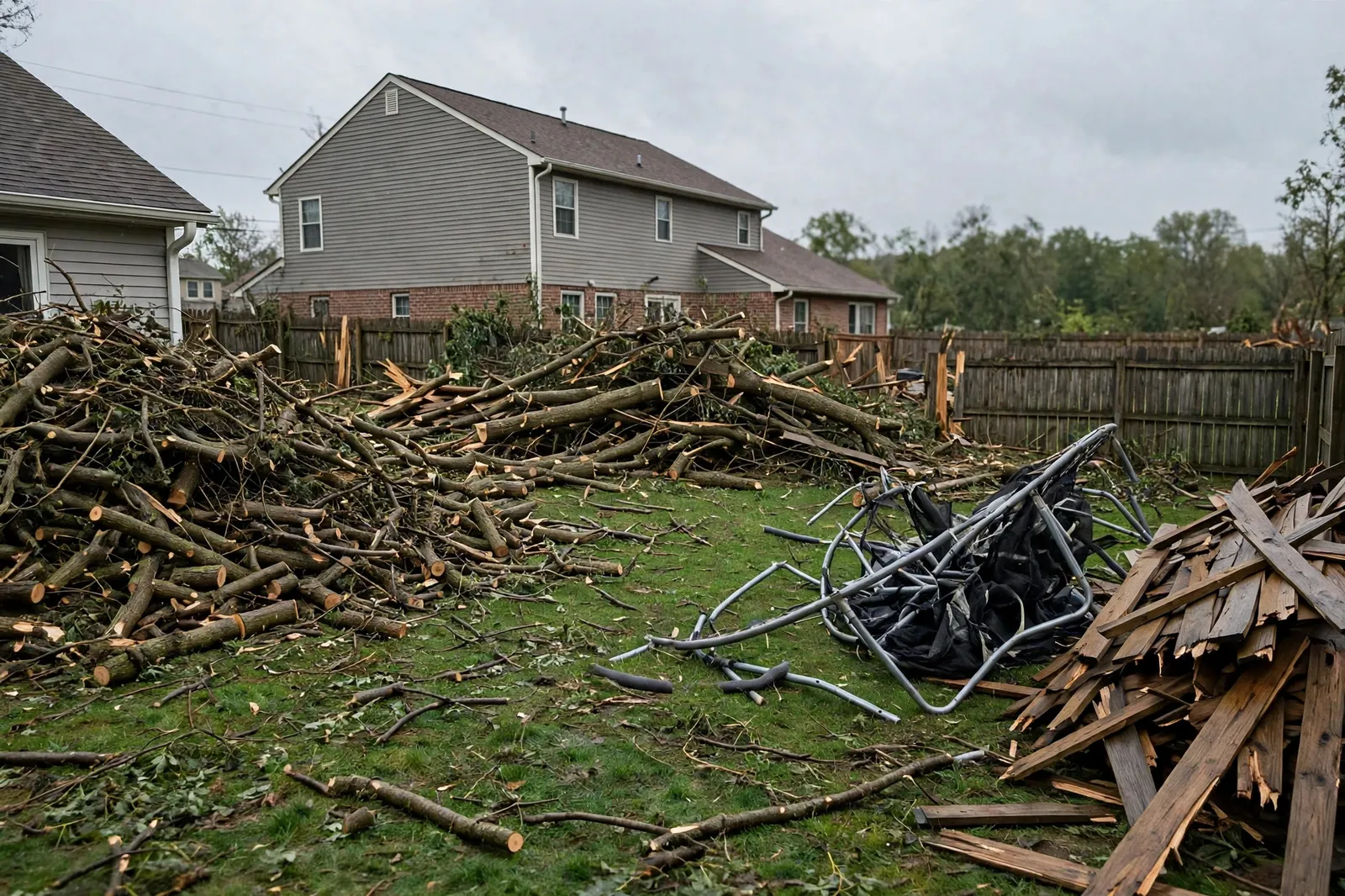
A Sheffield homeowner came home to two large limbs down across the back fence, four fence panels flattened, and a trampoline frame twisted into the shrubs. The crew loaded the limbs, the panels, and the frame, gathered the loose branches scattered across the lawn, and left the yard clear and the fence line open for the repair crew.
Storm loads are mostly volume. Brush and branches are light but bulky, fence panels and waterlogged furniture ride heavier, and disposal at the Charles County landfill is charged by weight where weight applies. The published market figures give the shape: one Waldorf operator publishes pickup loads starting at $100, and regional operators publish minimums around $125, about $265 for a quarter load, and about $695 for a full load. A typical storm yard lands near the quarter load mark, and a yard with fence sections or a shed's worth of wreckage climbs from there. These are published market figures, offered as education rather than a price list of our own. The figure for your yard is confirmed by the volume on site before loading begins.
Curbside yard waste programs take bundled branches in limited amounts, and a storm does not produce limited amounts. The rest becomes landfill trips, usually in a borrowed vehicle, one partial load at a time, while the pile kills the grass under it and the fence stays open. A single hauling visit ends that cycle. We load from where the debris lies, carry it from the back yard rather than asking you to drag it to the curb, and sweep the patio and driveway areas the work touched.
No. Cutting and climbing are tree work, a different trade, and we never offer them. Once limbs and branches are on the ground, we load and haul them. A standing, leaning, or hung up tree needs a tree service first.
Yes. Fence panels, posts, and gates are standard storm debris. Posts pulled out with concrete footings still attached ride heavy, and that weight is factored into the figure confirmed on site.
Published figures put local pickup loads as starting at $100, regional minimums around $125, a quarter load at about $265, and a full load at about $695. Most single yard storm cleanups land near the quarter load mark, priced by the volume the debris actually takes up.
Yes. Waterlogged carpet, padding, furniture, and other non hazardous household items ruined by storm water are part of this work. Describe what is inside and what is in the yard in the quote form.
No. We load debris from where it lies, including back yards and side yards, and carry it out. Keeping gates and the carry path reasonably clear helps, but the dragging and loading are ours.
Anything still attached to a standing tree, since we haul only what is down. Hazardous material like fuel, chemicals, and solvents also sits outside this service and belongs with the county household hazardous waste program.
Tell us what is going and roughly how much of it there is. We read every request that comes in and respond with the load size your description suggests and the published market range for that volume, and the price is confirmed by volume once the crew sees the actual load.
Prefer to talk it through first? Send the form and we will call you back at the number you give us.